
Rethinking Service Provider Oversight in the Age of Complexity
Outsourcing has long been the industry’s answer to scalability, but for many asset managers, the oversight model has remained stagnant. As products grow more complex, regulators move the goalposts, and vendors shift how they provide services, especially in the age of GenAI, firms must revisit their vendor management and oversight framework. The question is no longer whether oversight exists, but whether it is designed for the risks of today’s operating environment.
From Habit to Intentional Design
Most oversight frameworks are not designed — they accumulate. They inherit legacy review routines, replicate historical controls, and absorb the preferences of particular boards or executives. Over time, these routines become embedded even as products, scale, and risk profiles change beneath them. What began as prudent supervision quietly becomes either unnecessary duplication or insufficient challenge, often both at once in different corners of the organization.
An effective oversight model must be intentional. It should reflect the firm's risk appetite, complexity, growth ambitions, and regulatory posture — and it should be revisited as those things evolve.
At its core, oversight is about understanding where real risk resides within the outsourced value chain and concentrating monitoring effort accordingly. Not all processes are equally material. Not all providers carry the same exposure. Not every discrepancy warrants the same escalation. Firms that internalize this move beyond checklist supervision toward structured, risk-aligned governance.
A More Complex Landscape
The stakes of getting this right have increased. Asset managers today operate across a broader and more intricate product landscape than at any point in the past decade. Alternatives, hybrid vehicles, private assets, ETFs, and multi-strategy platforms introduce valuation complexity, liquidity considerations, and operational dependencies that traditional oversight routines were never designed to address.
At the same time, regulators and boards are asking sharper questions — about service provider governance, control transparency, and escalation readiness. The margin for vague or reactive answers has narrowed.
GenAI is also changing how service providers operate, how data & information is accessed, and what oversight means. Automated reconciliations, AI-assisted exception management, dynamic reporting, and real-time risk flagging are quickly becoming embedded in 3rd party operating models. This increases speed and scalability, but it also introduces new risks, data lineage questions, and governance obligations that oversight frameworks must account for.
Against this backdrop, many organizations find themselves caught between two inadequate extremes. On one end are models that attempt to replicate outsourced activities internally. While this can provide comfort, it typically creates cost drag and misdirects effort toward immaterial differences. On the other end are relationship-driven approaches that rely heavily on provider reporting and periodic governance meetings, sometimes without genuine independent challenge.
Neither extreme offers resilience. The more durable path lies in disciplined, risk-based oversight — not less scrutiny, but scrutiny directed where it matters most.
Designing Your Oversight Model With Intention
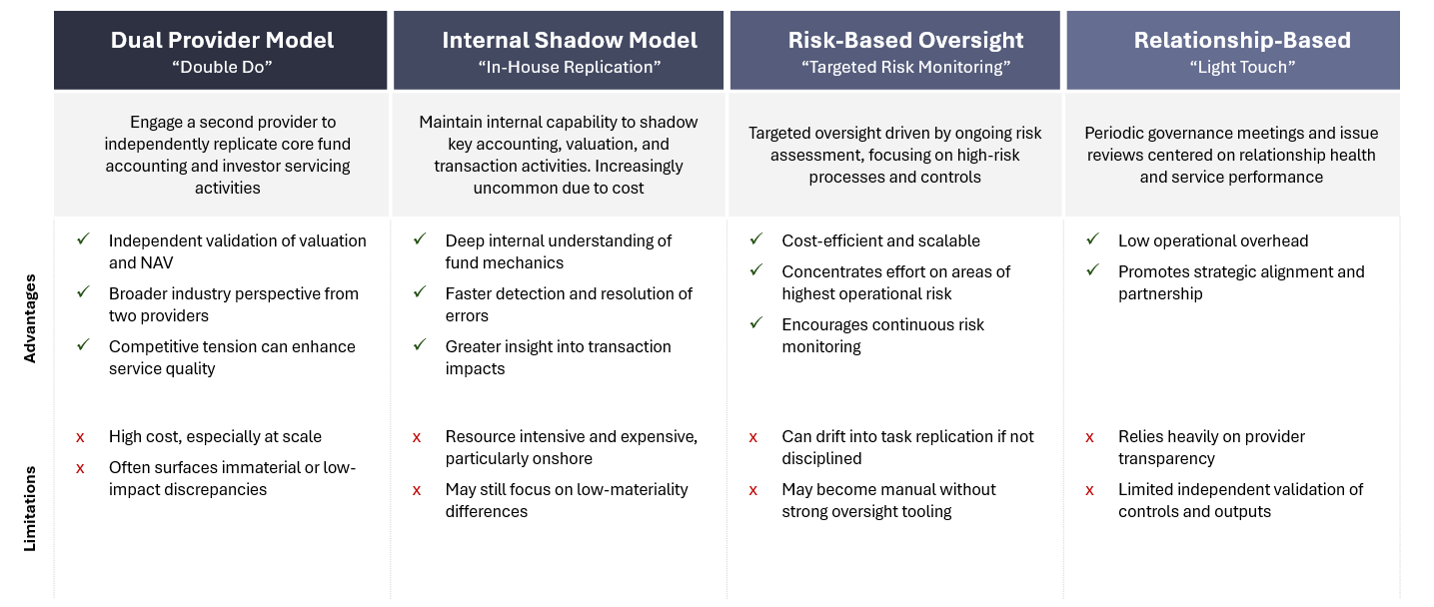
Oversight is not a one-size-fits-all construct. It is a strategic expression of how an asset manager views risk, how developed its internal operating model truly is, and how much cost and complexity it is willing to absorb in the name of control. Some firms with low risk tolerance and significant scale choose to replicate critical activities through a second provider, effectively validating outputs independently.
Others maintain internal shadow capabilities to deepen transparency and control insight. Many are shifting toward targeted, risk-based oversight models that concentrate monitoring efforts on material processes and high-impact exposures rather than duplicating tasks. At the lighter end of the spectrum, certain organizations rely primarily on governance routines and relationship management to supervise their providers.
These approaches exist along a continuum, ranging from heavy replication to partnership-driven governance. The right position on that spectrum depends on product complexity, regulatory expectations, board posture, operational depth, and growth trajectory. Defining the appropriate model requires conscious calibration, not defaulting to what has historically been done or what peers appear to be doing.
What Strong Oversight Actually Looks Like
Effective oversight frameworks share a set of defining characteristics. They are continuous rather than episodic. They adapt as products scale and new strategies launch. They are led by professionals who understand fund mechanics and operational risk — not solely by administrative review teams. And they calibrate intensity based on demonstrated control maturity rather than applying a static level of review to everything equally.
They also treat service providers as accountable partners within a structured governance architecture. Effective oversight is not adversarial — but it is not passive either. It establishes clear expectations, defined escalation channels, documented challenge processes, and transparent board reporting. When issues arise, the response is guided by pre-defined frameworks rather than improvised under pressure.
GenAI tools are also evolving to support oversight. AI today is used not only to identify exceptions but now also to explain them. For example, tools can be implemented to analyze why a stock moved day over day relative to its benchmark or a defined threshold.
Monitoring routines in these models generate insight rather than simply confirm completion. The focus is on understanding control design, not just reviewing outputs.
Designing for Resilience: Oversight Principles
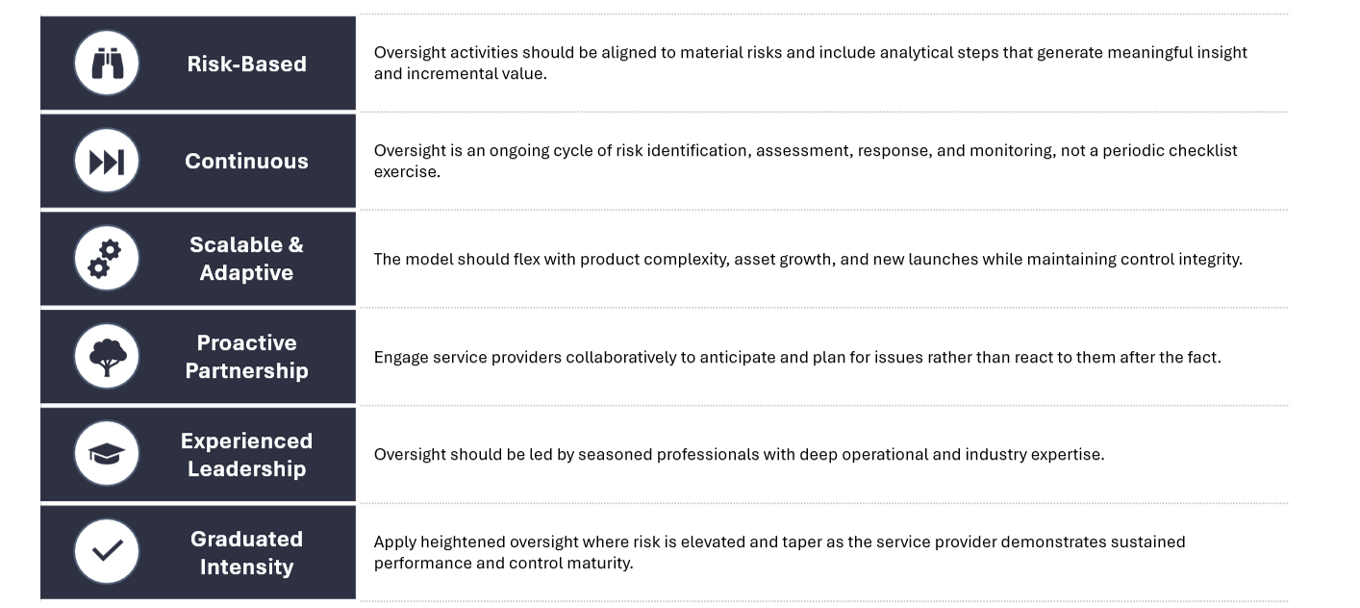
Defining the structure of an oversight model is only part of the equation. How that model operates day to day, how it evolves as the business grows, and how it responds under pressure ultimately determine its effectiveness. Many firms have governance routines in place, but fewer have clearly articulated the principles that anchor those routines and guide decision-making over time.
In an environment of expanding product complexity, heightened regulatory focus, and rapid technological change, oversight must be grounded in more than process. It requires a set of foundational characteristics that shape how risk is identified, monitored, escalated, and communicated.
The framework below highlights the core principles that should underpin any modern service provider oversight program.
Where Oversight Most Often Breaks Down
In our experience, oversight gaps rarely stem from a lack of activity. They stem from misalignment.
Firms may conduct extensive reviews that do not map to material risk. Governance meetings may focus on service metrics rather than operational exposure. Annual risk assessments may lag behind new product complexity. Documentation may exist, but escalation protocols may be unclear — or untested.
These weaknesses often remain invisible until a material event forces the question. A valuation issue, a NAV error, a control breakdown, or a technology disruption can quickly reveal whether the oversight model was built for resilience or merely for compliance.
How Beacon Can Help
There is no universal template. Each asset manager must calibrate its oversight model to its own complexity, product range, and growth ambitions. But the design must be deliberate, documented, and defensible.
For firms reassessing their service provider governance — or seeking to build a more scalable, risk-aligned oversight architecture — an objective outside perspective can clarify where replication can be reduced, where monitoring should be strengthened, and how governance can evolve alongside the business.
Beacon is comprised of industry experts who have designed, operated, and remediated oversight frameworks from the inside. We bring practical experience across fund administration, custody, middle office, and board governance combined with a forward-looking perspective on data, analytics, and genAI-enabled monitoring.
Reach out to discuss how we can help shape your vendor management and oversight models.