
Year 20AI: The Future Agentic Operating Model for Asset Management
“It’s very clear that AI is going to change literally every job,” said Walmart CEO Doug McMillon in 2025. “Maybe there’s a job in the world that AI won’t change, but I haven’t thought of it.” This view isn’t confined to the world’s largest retailer. It is increasingly echoed across financial services, with JPMorgan CEO Jamie Dimon comparing AI’s impact to electricity itself.
For capital markets leaders, this is a structural inflection point, not a distant trend. GenAI will redefine how work gets done, how decisions are made, and how value is created. Firms must move beyond treating GenAI as a technology initiative and instead rethink core business processes, operating models, and culture. Every role in asset management, from research analysts to client advisors to back-office teams, is already being reshaped by AI. Firms that embrace this disruption will unlock meaningful competitive advantage. Those that hesitate risk being outpaced by organizations operating at speeds and scales they cannot replicate.
This whitepaper presents a blueprint for the agentic operating model. It focuses on an architecture defined by intelligence & context lineage, embedded governance, orchestration across human & AI actors, and deliberate human oversight. The winners in the Year 20AI era will move beyond experimentation to embed GenAI enterprise-wide. They will redesign workflows for true human–AI collaboration, treat AI as a strategic capability rather than a narrow efficiency lever, and invest in talent transformation and governance. Asset managers that reimagine their operating models today will define the next era of competitiveness, client service, and innovation. The time to build your Year 20AI architecture is now.
The Current Operating Model: A linear, highly dependent process
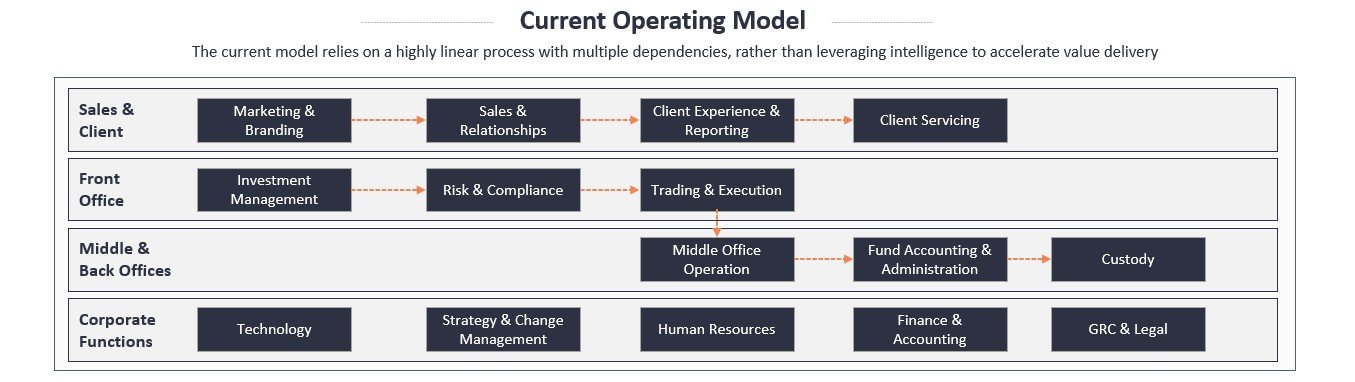
Despite massive advances in data, technology, and analytics most firms still run their businesses as if work must move one function at a time. The prevailing operating model is organized around rigid functional boundaries, with each group optimized for a narrow stage of the investment and client lifecycle. Work advances linearly across sales & client teams, front office, middle &back office, and corporate functions.
Historically, this model delivered scale, risk management, and accountability. However, it also introduced structural friction. As client expectations rise and data volumes and operational complexity accelerate, the limitations of a strictly functional, handoff-driven operating model become increasingly evident. In the age of GenAI, this model is increasingly antiquated. As firms have evolved their operating models in past eras of structural change, they must now pivot again to remain competitive in Year 20AI. Characteristics of current model:
Coordination occurs through formal handoffs, documentation, and controls as work passes from one team to the next
Technology systems tend to reinforce these boundaries, with specialized platforms supporting discrete parts of the value chain
Information is transferred rather than shared
Roles and skillsets are tightly aligned to the function an individual sits within
Decisions are often delayed by dependencies across functions
What Do We Mean by Agentic Operating Model
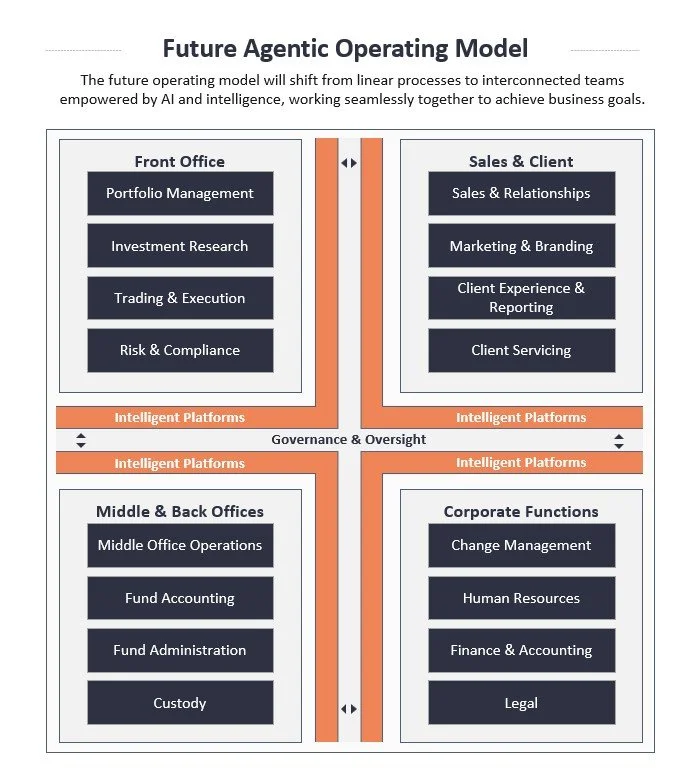
The future of asset management is not about faster handoffs or smarter automation. It is about dissolving the boundaries that made handoffs necessary in the first place. In an agentic operating model, work no longer moves sequentially through functions. Instead, it flows dynamically across an intelligent network of humans and AI agents, coordinated through embedded context and real-time orchestration. The shift is from process execution to outcome orchestration.
In this model, intelligence is not accessed through tools or dashboards. It is woven directly into the flow of work. AI agents are embedded within workflows, continuously sensing context, anticipating needs, and taking action. They analyze data, draft communications, monitor exceptions, coordinate work across systems and teams, and surface insights precisely when and where they matter. Humans contribute judgment, creativity, relationship depth, and accountability. Together, they form an interconnected system where capability flows to the point of highest value.
Teams are no longer defined by function but by mission. Work does not move through departments. It flows across an intelligent network. Decisions are no longer constrained by hierarchy. They occur at the speed of insight.
The result is an operating model that scales expertise without dilution, increases speed without sacrificing quality, and enables personalization without unsustainable headcount growth. Most importantly, it allows firms to deliver better client outcomes, faster innovation, and more resilient operations by working more intelligently, not harder.
Building Blocks of the Agentic Operating Model
An agentic operating model cannot be achieved by layering AI tools onto existing processes. It requires a deliberate re-architecture of both the tech stack and the way work is organized. Firms that succeed will rethink their operating model across a set of foundational building blocks that together enable intelligent, scalable, and governed human-AI collaboration. Together, these building blocks form the foundation of an agentic operating model, one that moves beyond productivity gains toward a structurally different way of organizing work in the GenAI era.
Embedded Intelligence & Context:
At the core of an agentic model is embedded intelligence that captures and institutionalizes knowledge. Rather than insights living in emails, spreadsheets, or individual expertise, they are persistently recorded, structured, and made accessible through AI-powered knowledge layers. These systems retain context, rationale, and historical decisions, allowing insights to be reused, queried, and built upon over time. This transforms knowledge from a byproduct of work into a durable enterprise asset.
Agent-Oriented Workflow Design
Agentic models introduce autonomous execution engines that can carry out defined processes end to end within approved boundaries. These agents operate continuously, responding to triggers such as data changes, events, or thresholds. Critically, autonomy is conditional, not absolute. Agents are designed to recognize when human judgment is required and to escalate decisions, exceptions, or ambiguity to the appropriate individuals. This allows firms to automate at scale without compromising accountability or control.
Orchestration & Decision Fabric
Traditional automation bolts AI onto existing processes. Agentic systems embed intelligence directly into workflows as an active participant coordinating across functions and systems. Work flows dynamically through an orchestration fabric rather than rigid handoffs. Agents pass context and insights to one another and to humans in real time, adapting as conditions change. The op model becomes fluid, responsive, & resilient in ways process maps never allowed.
Continuous Learning System:
Agentic operating models evolve in real time through continuous learning that improves based on outcomes and feedback not periodic retraining cycles. Human-in-the-loop allows teams to correct, guide, and calibrate agents. When someone refines an agent's output, that learning propagates across the system, improving quality firmwide. Performance analytics measure outcomes not just activity. Over time, agents internalize preferences, risk standards, and decision-making nuances, becoming more effective, aligned, and trusted.
Functional Impacts Across the Organization
Front Office
In traditional front office operations, investment expertise lives in individual analysts and portfolio managers. Research sits in reports. Alpha generation depends on who you know and what you remember. In an agentic operating model, intelligence is institutionalized and accessible in real time. When a portfolio manager evaluates a position, AI agents surface relevant research, flag similar situations, and synthesize overlooked signals. When an analyst identifies a thesis, agents test it against historical patterns and current exposures—instantly.
Investment decisions no longer wait for weekly meetings. Agents continuously monitor portfolios, surfacing opportunities and risks as they emerge. Humans define strategy; agents optimize allocations, rebalance dynamically, and ensure compliance in real time. The front office transforms from individual experts into a connected intelligence network. Alpha generation becomes systematic and scalable—not dependent on star performers.
Middle & Back Office
Middle and back office functions have long been viewed as necessary overhead—cost centers focused on controls and compliance. Work flows through rigid checklists. Exceptions trigger manual reviews. The agentic operating model inverts this logic. AI agents execute trade settlement, reconciliation, and reporting autonomously—recognizing patterns, anticipating issues, and resolving exceptions before they escalate. When anomalies occur, agents diagnose root causes and route to the appropriate resolution path. Routine actions process without human touch. Complex scenarios escalate with full context and recommended actions prepared.
Every transaction feeds the firm's embedded knowledge layer. Patterns invisible in traditional systems become visible. Risk signals from operations inform front office strategy in real time. The result is an operations function that scales without linear cost growth and becomes a competitive advantage rather than back-office burden.
Sales & Client
Traditional client service is reactive and resource-intensive. Advisors respond to requests and rely on personal relationships to retain assets. Personalization requires unsustainable advisor ratios. In an agentic operating model, client service becomes anticipatory and scalable. AI agents maintain continuous awareness of each client's portfolio, goals, and preferences. They monitor for triggers—market volatility, tax opportunities, regulatory changes—and proactively surface insights with recommended actions.
When clients reach out, advisors have complete context instantly. Agents draft communications, generate analyses, and prepare materials—freeing advisors to focus on relationship depth and strategic guidance. This intelligence is shared across the organization. When one advisor navigates a complex scenario, that expertise becomes available to everyone.
Corporate Functions
Corporate functions traditionally operate as centralized support services responding to requests. Work is sequential: legal reviews contracts, compliance approves products, IT provisions systems. Each function optimizes for its own efficiency, often slowing overall speed. The agentic operating model transforms these functions into strategic orchestrators. Compliance agents monitor regulatory changes and automatically update affected processes. Legal agents assist with negotiations in real time, flagging risks based on precedent. Finance agents generate forecasts dynamically. HR agents identify skill gaps and match employees to opportunities.
Corporate functions become enablers rather than bottlenecks. Governance happens within workflows. Policies adapt in real time. The result is a firm that moves faster with greater control—not despite governance, but because of it. Corporate functions shift from defense to offense.
What This Means for Your Organization
AI adoption is no longer a future consideration—it's a present-day imperative reshaping asset management. Firms must transform their operating models now or risk falling behind competitors who are already capturing advantages. This shift extends beyond technology to workforce composition, role definitions, workflows, and performance metrics. Decisive action today creates compounding advantages in productivity, talent, and client service that laggards will struggle to match.
Scale Without Proportional Growth
AI is increasing output without adding headcount. Research teams are seeing 15–35% productivity gains and operations teams over 20–35% throughput improvement. The real advantage is the ability to manage greater complexity with the same or fewer people, breaking the linear link between capacity and headcount. Leaders must deliberately redeploy freed capacity into higher-value work, growth, or risk coverage.
Roles Will Compress and Be Redefined
Some roles will shrink or disappear, while others expand. Work is shifting from execution and first drafts toward judgment, exception management, and advisory responsibilities. New roles are emerging to design workflows, supervise AI, manage risk, and validate outcomes. Winning firms are reskilling now and redefining career paths before role erosion sets in.
Hierarchies Will Flatten
AI agents allow individuals to oversee work that once required large teams, fundamentally changing how capacity is managed. As a result, career progression shifts away from managing people and toward owning outcomes such as quality, throughput, and results across AI-enabled processes. Organizations must redesign structures, decision rights, and accountability models to support faster, flatter execution and clearer ownership in an AI-augmented environment.
AI Requires Ongoing Management
AI behaves less like traditional software and more like critical infrastructure that must perform reliably under changing conditions. Models drift, outputs degrade, and risks evolve, requiring continuous monitoring, clear escalation paths, and active intervention. Firms need dedicated AI operations and governance capabilities with clear ownership, performance metrics, and accountability, treating reliability, quality, and resilience as ongoing management responsibilities rather than one-time implementation tasks.
AI Fluency Is Table Stakes
AI fluency is no longer optional. Investment, client-facing, and operational teams must understand how AI generates outputs and how to work effectively in human-machine workflows. Firms without AI-fluent talent will struggle to validate decisions, manage risk, and maintain trust. AI fluency must become a hiring, development, and promotion priority.
The Winners' Playbook: What Leaders Do Differently
As GenAI becomes widespread, advantage will not be evenly distributed. The winners of the Year 20AI era will be defined by ambition, execution, and culture, not size. They will be the firms that most deliberately embed AI into how work gets done.
Workflow Redesign, Not Automation: Winners redesign end-to-end workflows around human–AI collaboration rather than layering AI onto legacy processes.
AI-Fluent Talent & Culture: Firms upskill teams, recruit selectively, and frame AI as augmentation, fostering experimentation and adoption.
Clear Executive Ownership: Strong C-suite sponsorship sets vision, secures funding, and removes silos, signaling AI is a strategic priority.
Embedded Governance & Trust: Responsible AI is built in from day one, with risk and compliance engaged early to enable speed with confidence.
Operational Resilience & Change: Effective change management ensures adoption sticks through clear communication, training, and transition planning.
Ecosystem & Partnerships: Leading firms leverage vendors, data partners, and peers to accelerate innovation rather than building everything internally.
Conclusion: The 20AI Inflection Point
GenAI is not an incremental technology upgrade—it is a fundamental restructuring of how firms create value, serve clients, and compete. The operating models that powered success over the past two decades are becoming liabilities. Speed, scale, and personalization now require intelligent orchestration between human expertise and AI agents.
The agentic operating model represents this new architecture. It eliminates handoff friction, embeds intelligence directly into workflows, and allows firms to deliver institutional-grade insights and service at scale. Organizations that build this capability will compound advantages that competitors cannot easily replicate. Those that delay will face a widening gap—not just in efficiency, but in their ability to attract talent, retain clients, and sustain relevance.
The winners in Year 20AI will not be determined by size or legacy. They will be the firms that act decisively, invest boldly, and commit to transformation at the operating model level. The question is no longer whether AI will reshape asset management. It is whether your firm will lead that transformation or react to it.